





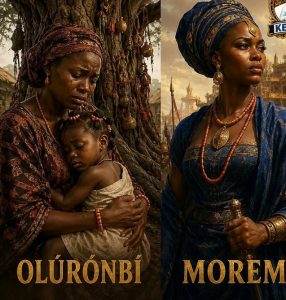
Have you ever heard the Yoruba story of Olúrónbí? A story that has been told for generations, warning people about the danger of making promises out of desperation.
Long ago, there lived a woman named Olúrónbí who deeply desired to have a child. Like many women in those days, she prayed and searched for a solution because motherhood was considered a great blessing.
According to Yoruba oral tradition, Olúrónbí and her husband longed for a child. In her search for help, she went to the sacred Ìrókò tree, which was believed to be connected with a powerful spirit.
She begged the Ìrókò spirit to bless her with a child.
In her desperation, Olúrónbí made a serious promise to the Ìrókò spirit that if the spirit answered her prayer and blessed her with a child, she would give that child back to the spirit as an offering.
Not long after, her prayer was answered. The Ìrókò spirit answered her request, and she gave birth to a beautiful baby girl. According to some versions of the Yoruba tradition, the child was named Bẹ́pòrẹ́ (Bepore).
The little girl became the joy of Olúrónbí’s life. She loved her daughter more than anything in the world. The child was still very young, and Olúrónbí could not imagine losing her.
But the promise she made came back to haunt her.
The Ìrókò spirit came back to ask for what Olúrónbí had promised.
When the time came for Olúrónbí to fulfill her vow, she could not give up her daughter. She tried to replace the child with goats, sheep, and other gifts, but according to the story, the Ìrókò spirit refused to accept the replacements.
According to Yoruba oral tradition, the Ìrókò spirit later came to claim what had been promised and took away Olúrónbí’s young daughter away. Her sorrow and regret became a lesson that was passed from one generation to another.
That is why Yoruba people still remember the famous song: 🎵🎷
🎹🎵🎶Oníkálùkù jẹ́jẹ́ ewúrẹ́
Ewúrẹ́, ewúrẹ́
Oníkálùkù jẹ́jẹ́ àgùtàn
Àgùtàn bólòjò
Olúrónbí jẹ́jẹ́ ọmọ rẹ̀
Ọmọ rẹ̀ a pò́n bíi epo
Olúrónbí ò
Jọ̀un jọ̀un
Ìrókò
Jọ̀un jọ̀un 🎶🎤 3xxxxx
(Olúrónbí promised her own child)
The story teaches a powerful lesson: never make a promise you cannot keep, especially when emotions and desperation control your decisions.
But many people confuse Olúrónbí with Moremi Ajasoro. Are they the same person?
NO. They are completely different stories.
OLÚRÓNBÍ is a Yoruba folktale. It is a moral story passed down through oral tradition. It teaches about promises, regret, and the consequences of making dangerous vows. There is no widely accepted historical evidence proving that Olúrónbí was a real historical figure.
MOREMI AJASORO, on the other hand, is remembered in Yoruba tradition as a heroic figure connected with the history of Ile-Ife. According to tradition, she sacrificed her freedom by allowing herself to be captured by the enemies of Ife so she could discover their secret and help save her people. After gaining the information, she escaped and revealed the secret, helping Ife defeat its enemies.
So while both stories involve sacrifice, they are not the same:
Olúrónbí = a tragic folktale about a broken promise.
Moremi = a heroic legend about courage and saving a kingdom.
Both stories remain important parts of Yoruba cultural heritage, but they carry completely different meanings.
History, culture, and tradition must always be told with wisdom.
Refrence: Facebook.
