



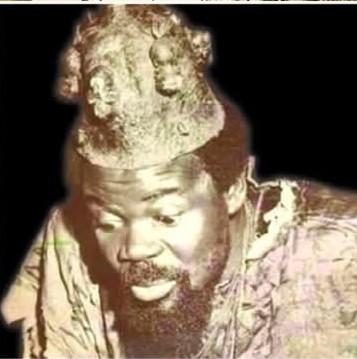
Durodola Adisa Ladipo was a Nigerian dramatist who transformed Yoruba theatre by weaving traditional music, dance, and folklore into powerful stage productions. He was very proud of his ethnicity.


In 1962, he founded the Mbari Mbayo Club in Osogbo, which he later developed into a full cultural centre for young artists honing their craft.
Born on 18 December, 1926, he was believed to be an ‘Abiku’ because he came after nine of his parents’ children passed away before the age of one. That is why his names included Durodola, Durosomo, Duroorike.
Despite the fact that both Joseph and Dorcas Ladipo were devout Anglican Christians who rejected the beliefs of their parents, they were so troubled by the apparent abiku possession that for Ladipo, they went to a traditional Ifa priest, or Babalawo.
Ladipo’s father wanted him to be a Christian, but the young boy was influenced by his grandfather who was a devout worshipper of Sango and Oya, and was versed in Yoruba mythology, especially those emanating from Old Ọyọ. Ladipo also observed Ifa and Egungun festivals at Ila Orangun and Otan Ayegbaju, towns near Osogbo. Ladipo always went out of the vicarage to watch Yoruba festivals.
This fascination with his culture goaded him into researching and experimenting with theatrical drama and writing. Throughout his career, Ladipọ wrote 10 Yoruba folk operas combining dance, music, mime, proverbs, drumming and praise songs. He started his personal theatre group in 1961, but he became fully established with the founding of the Mbari Mbayo Club in Oṣogbo.
- Durodola Ladipo popularity as the leader of a folk opera group rests on his three plays: Ọbamoro in 1962, Ọba ko so and Ọba Waja in 1964. He also promoted Mọremi, a play about the Yoruba ancestress of the same name. He later transformed Mbari Mbayo into a cultural centre, an arts gallery and a meeting point for young artists seeking to develop their talents.
- Ladipọ wrote quite a number of plays, including Suru Baba Iwa and Tanimowo Iku. Some of his plays were also produced for television. In fact, he created Bode Wasinimi for the Nigerian Television Authority, Ibada.
- In 1977, Ladipo participated in FESTAC ’77, the Second World Festival of Black and African Arts and Culture, in Lagos, Nigeria.
- In 1964, he married Abiodun Duro-Ladipo, his third wife, and she became a permanent member of the troupe. Ladipo passed away on 11 March 1978, at the age of 51 a short illness related to the liver.
- The day he passed on, there was sudden rain with lightning and thunder interpreted as a sign that Sango, the god of thunder and the main character of his most famous work, welcomed him into the heavens.
- He had four wives and 15 children, managed his home so well that there was absolute peace. He employed a nanny for the children. He bought a bus and employed a driver to convey his children to and from school.
- Asked in an interview if his father used magical powers while on stage, one of his sons said: “I would not deny that because during those days, plays were expected to be real, I mean true-to-life. There was no film trick. So, he could have invoked some powers to make his plays convincing.”
- His favourite foods were eba with boiled eggs. He also loved okro soup and pap.
