



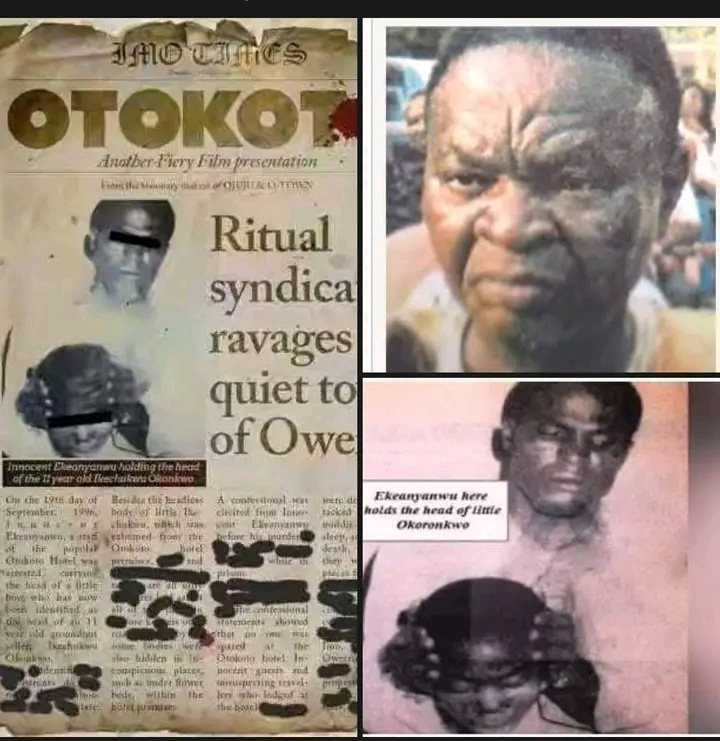
A Dark Chapter in Owerri’s History



On a regular September afternoon in 1996, 11-year-old Anthony Ikechukwu Okoronkwo set out to do what he did every day—sell boiled groundnuts on the streets of Owerri, hoping to make a little money to support his family. He had no idea that his innocent hustle would lead him into the hands of monsters.
As he walked through the Amakohia area of Owerri, a man called out to him. The man, later identified as Innocent Ekeanyanwu, was 32 years old. To young Anthony, this seemed like an opportunity—a customer at a hotel meant he might sell more groundnuts than usual. With the hope of returning home with more money, he stepped into the infamous Otokoto Hotel, completely unaware of the evil that awaited him.
Ekeanyanwu welcomed the boy warmly, offering him a bottle of Coca-Cola to cool off. It seemed like an act of kindness, but it was laced with poison. As Anthony sipped the drink, his vision blurred, and his small body grew weak. In a few minutes, he lost consciousness—never to wake up again.
What followed was a horror beyond words. Ekeanyanwu, a mere gardener at the hotel, carried Anthony’s limp body into a room. With chilling precision, he took a cutlass and beheaded the unconscious child. His body was dismembered—his liver, genitals, and other organs harvested. What was left of him was buried in a shallow grave on the hotel premises.
How the Secret Was Exposed
After the gruesome act, Ekeanyanwu placed Anthony’s severed head inside a polythene bag. He had a specific destination—the house of Chief Leonard Unaogu, a highly influential man who had ordered the killing.
To deliver the head, Ekeanyanwu hailed a commercial motorcycle (Okada). The bike man, Opara, noticed something unsettling—the polythene bag was dripping with fresh blood. His heart pounded as he put the pieces together. When Ekeanyanwu got off, Opara wasted no time. He rushed to alert the police.
Moments later, the police intercepted Ekeanyanwu. He was caught red-handed, still carrying the severed head of the little boy. Upon interrogation, he confessed that he was delivering the head to Chief Unaogu. However, upon reaching Unaogu’s house in Eziama, Ikeduru, he was told the chief had traveled to Lagos. With no alternative, he returned to Owerri with the head—only to walk straight into the hands of the law.
Owerri Erupts in Rage
When news of Anthony’s brutal murder broke, Owerri boiled with outrage. The people had had enough. The city had long been plagued by mysterious disappearances and ritual killings, but there had never been solid proof—until now.
Images of Ekeanyanwu holding the severed head of Anthony Okoronkwo were broadcast on local television. The intent was to assure the public that justice would be served, but instead, it unleashed chaos. The sight of the innocent child’s head in the hands of a killer sent Owerri into a full-blown riot.
People abandoned their businesses and flooded the streets in thousands. Furious mobs matched to the Otokoto Hotel and burnt it to the ground. But they didn’t stop there. The crowd targeted properties belonging to the rich and powerful—especially those rumored to be involved in ritual killings.
Luxury hotels, businesses, and private mansions were set on fire. The residence of Chief Vincent Duru, the owner of Otokoto Hotel, was not spared. His expensive cars were destroyed, his house looted, and he barely escaped with his life. Other buildings linked to suspected ritualists, including Piano Plaza, Chibet Hotel, and various other businesses, were completely demolished.
For two straight days, Owerri was on fire. The people wanted justice—not just for Anthony but for every child who had vanished without a trace.
A Corrupt System Protects the Killers
Despite his arrest, Ekeanyanwu would never face trial. Just four days after his capture, while still in police custody, he was found dead—poisoned. His sudden death raised suspicions that powerful figures were trying to cover up the truth.
But before he died, he had already revealed enough. He confessed that the ritual killings were a well-organized network that specialized in harvesting human body parts for rituals. His death only confirmed the public’s worst fears—that even those meant to enforce the law were part of the darkness.
The Trial and Justice That Took Years
In the wake of the riots, the government launched an investigation. Shockingly, mass graves were discovered on the Otokoto Hotel premises. Over 24 bodies were exhumed, including travelers who had checked into the hotel and never left. Some victims had been drugged and slaughtered in their sleep, their organs sold to the highest bidder.
The investigation implicated Chief Vincent Duru, Leonard Unaogu, and several other highly placed individuals. But justice was slow. The legal process dragged on for years, allowing many of the key suspects to escape punishment.
However, in 2002—six years after the murder of Anthony Okoronkwo—Chief Vincent Duru and six others were sentenced to death by hanging.
A Painful Reminder
The Otokoto ritual killings remain one of the darkest moments in Owerri’s history. It exposed the deep rot within the system—a system where the rich and powerful could take innocent lives without consequences.
Anthony Ikechukwu Okoronkwo was just a little boy trying to help his family survive. He never imagined that a simple act of selling groundnuts would lead him into the hands of evil.
His tragic death awakened a city. It forced the people of Owerri to rise against the wickedness that had thrived in silence for too long. But his story is also a reminder—a reminder that beneath the glamour of sudden wealth, there are often secrets too horrifying to imagine.
