



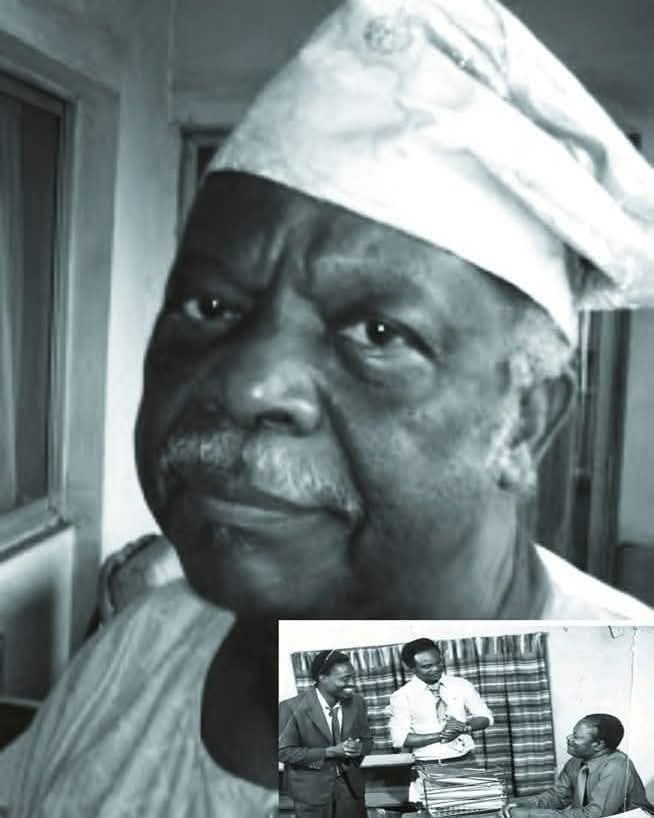


Whenever Nigerians use the words “Amebo” (for a gossip/ gossiper) or “Gorimapa” (for a bald-headed person), few realize they’re invoking the legacy of one of Nigeria’s television pioneers — Ambassador Olusegun Olusola.
Olusola was the creator of The Village Headmaster, Nigeria’s longest-running television drama at the time, which first aired in 1968 and continued until 1988. Through the program’s storytelling, characters, and language, many colloquial terms found their way into everyday Nigerian speech.
The character Amebo, portrayed by Ibidun Allison, became synonymous with gossip and rumor-mongering.
Gorimapa, played by Chief Albert Kosemani Olayemi, was a nickname used to describe someone who was clean-shaven or bald-headed — a humorous and memorable figure in the show.
A Life in Media and Diplomacy
Born on March 18, 1935, Olusegun Olusola was a television producer, broadcaster, and later a respected diplomat. He studied broadcasting at the University of Pittsburgh, USA, before returning to Nigeria in 1955, where he joined the Federal Radio Corporation of Nigeria (FRCN) as a broadcasting officer.
By 1959, he had moved to the Nigerian Television Authority (NTA) and rose steadily through the ranks. He became an executive producer in 1964, the same year he began scripting The Village Headmaster. The show officially launched in 1968 on NTA and ran for two decades, becoming a cultural phenomenon.
Olusola later served as:
Vice Chairman of the Broadcasting Organisation of Nigeria’s Planning Committee for the 1973 All-Africa Games.
Controller of Programmes at the Nigerian Broadcasting Commission (1965–1974).
Director of Programmes at NTA Lagos in 1974, and later its General Manager in 1976.
In 1987, he was appointed Nigeria’s Ambassador to Ethiopia and the Organisation of African Unity (OAU) by then military President Ibrahim Babangida.
Legacy
Ambassador Olusola passed away on June 21, 2012, at the age of 77. Beyond his media and diplomatic achievements, his contributions to Nigerian culture — including the popularization of terms like Amebo and Gorimapa — continue to live on in the nation’s collective memory.
